
By Mayuri Parmar
NHSF (UK) PR Team
Associated Press
This week has seen the worst riots in living memory for most people in major cities across the UK. Looting, petty theft and acts of violence on properties and homes have defined the past few days in London, Birmingham, Manchester, Bristol and Liverpool. Many of the perpetrators should have been enjoying their summer holidays. Instead, kids as young as ten swarmed the streets, smashing shop windows, throwing petrol bombs and stealing anything that they could get their hands on.
Whatever the feeble excuse; frustration against the establishment for perceived non-cooperation, current socioeconomic woes, or even a case of misguided peer pressure; this kind of event offends our human spirit and intelligence- leaving us feeling insecure and nervous in a country that prides itself on public order and adherence to the rule of law. Permitting oneself to spread chaos and ruin livelihoods is despicable. NHSF (UK) categorically condemns the attacks and wishes to pass on its thoughts and regrets to those that have been affected by the violence and damage.
There are two key questions for the youths who took part in riots, which need to be addressed by politicians and the wider community. Firstly, where are their guardians? Parents and guardians are normally ascribed the duty of teaching good values and respect. Dharmic thought refers to this as ‘sanskar’. Although difficult to define, the term has been interpreted as ‘a process, which transforms a person into an ideal & outstanding personality by diminishing the negative mental tendencies existing in them and by inculcating human values & qualities to make them more dynamic, valuable and responsible towards themselves, as well as the society’. Surely guardians have a pivotal role in preventing these youths from committing such awful crimes.
Secondly, what has caused individuals to react in such an irrational way? There needs to be honest, open and proper engagement with youths from across the country. With so many ready to jump on a bandwagon, and not seemingly understanding why they are doing so, there is a deeper social issue brewing under the fabric of modern British society. This needs to be understood and tackled to ensure that the supposed ‘lost generation’ is not ignored.
Another issue that commentators have failed to mention, or which has been obscured by the blame placed on ‘violent consumerism’, is that this crisis has illuminated the priority of wants over needs in our society. The capitalist system is one that, through choice, creates wants. Whether it is wanting to buy organic, rather than standard milk, or (for the fashionistas) buy a Gucci bag over a Primark one – these choices can often better our standard of living and well-being. When viewed through the lens of these riots, however, these wants manifest themselves into something far uglier. Interestingly, the targets for looters were fashion and jewellery shops, gadgets and mobile phone retailers. Youths were willing to smash shops to get their hands on a new pair of Nike trainers, or an IPhone 4. They were never going to break into a Waterstone’s to steal the latest best-selling novel. Do we need to ask ourselves what image we are promoting by continually feeding these wants for newer, shinier, better things? Is it possible that these wants have taken over and are being mistaken as basic needs- to the extent that people are willing to commit crime for them? This certainly needs to be discussed.
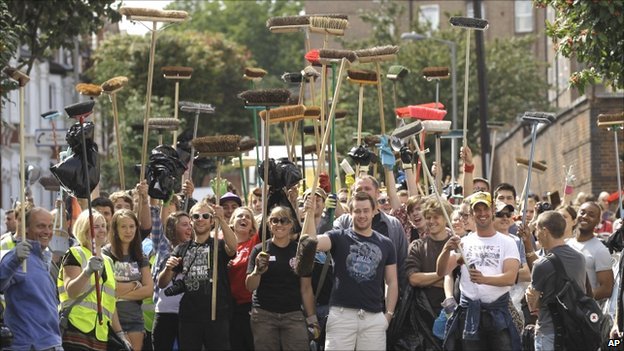
There is, however, a lotus flower of hope in the dark and murky story that has been depicted over the past few days. People, regardless of race, religion or background have rallied together to help clean up and rebuild communities. Across England, people took to the streets with brooms, clearing up the debris leftover from the riots. The Turkish community rallied in Dalston, protecting businesses and homes, whilst the Kurdish vowed to protect Croydon from further attacks, and the Sikh community stood firm outside their gurdwara in Southall. Similarly, the Hindu community, alongside others took to the streets in Redbridge, North-east London yesterday to protect the neighbourhoods in which they have grown up. Far more people have joined social networking groups to help rebuild, than joining groups to riot. This solidarity shows that the human spirit is capable of so much more when they work together selflessly, and with the aim of positively building, rather than destroying communities.