
By Sanjay Parekh
NHSF Learning Team
Annakut / New Year
The Hindu New Year (Nutan Varsh), fall on the first day of Kartik (the first month in the Hindu calendar).
Origins
As well as signifying the start of the New Year, there are two origins why we celebrate New Year.
On Kartik 1, Lord Vaman asked King Bali for three strides of land (Devpodhi Ekadashi). King Bali pleased the Lord by offering all his land. In gratitude for his devotion, Vamanji gave Bali a boon that named this auspicious day after him. So, Kartik 1 is also known as ‘Balipratipadaa’ and people offer Bali Puja on this day.
The second origin is the beginning of ‘Annakut’.
The monsoon, which commenced in the month Aashwin, helped the growing of new crops by the end of month. Therefore, the harvest brought home is first used to cook exquisite food for the Lord. In Gokul, where Lord Krishna grew up, it was commonplace to offer these foods as prashad as thanks to Lord Indra, who graces rain, helping crops to grow.
On this day, Sri Krishna pointed out that the cause of man’s happiness and misery are his karmas. And the supreme God bestows the fruits of these karmas. He added:
‘Since we are forest dwellers, Puja of this Mount Govardhan, the cows and Brahmins, is greater than Indra’s Puja. From now onwards, fodder shall be offered to cows and food to Govardhan’
(Shrimad Bhagvatam 10/25)
Everyone accepted his ‘agna’ (wish). When Indra discovered that his Puja had been stopped, and instead, Puja offered to Govardhan in Gokul, he unleashed his wrath by deluging Gokul with rain to destroy it. However to demonstrate the Lord’s power, Shri Krishna raised Mount Govardhan merely with his little finger, thus sheltering the residents and cattle of Gokul underneath.
This shows us that factors such as houses, wealth, mountains, trees or the earth do not have the power to protect us. Only the Lord Purushottam has the power to deliver us. Therefore it is best to accept ‘sharnagati’ (refuge) of the Lord Supreme and offer Him Puja.
Over the ages, these sentiments have been consolidated by offering Govardhan Puja. This is also known as ‘Annakut’, ‘Anna’ meaning food and ‘Kut’, mountain.
Celebrations
Celebrations are very festive as New Years day follows Diwali. People go to Mandirs for darshan of God and greet each other on this day by uttering ‘Nutan Varsh-abhinandan’ or ‘Saal- Mubarak’.
In Mandirs, ‘Annakut’ is offered to the deities on this day. A vast array of vegetarian foods is traditionally arranged in tiers or steps, in front of the Lord. The sweets are placed nearest to the Lord. As the tiers descend, other foods such as ‘dal’, vegetables, pulses and fried savoury foods are arranged. A mound of cooked rice, symbolic of Mount Govardhan, is placed in the centre. This is followed by a grand Aarti. The Annakut is left for darshan until evening, and then the items are distributed as prashad.
In the whole of the Hindu Dharma and perhaps the world, the grandest offering and display of vegetarian cuisine happens every year during the Annakut at the Shri Swaminarayan Mandir, in Neasden London. Stretching 85 feet in length, with several tiers of food, there are over 1250 different vegetarian food dishes offered in a spectacularly devotional and aesthetic manner. This is a breathtaking feast for all to observe.
Bhai-Dhuj
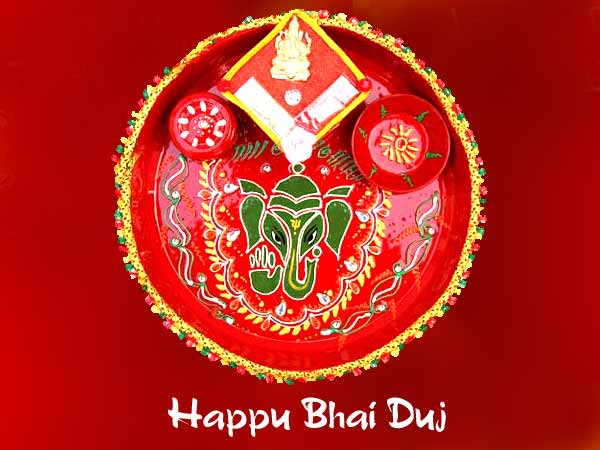
Bhai-Dhuj (Hindi) (also Bhau-beej (Marathi), Bhai-Beej (Gujarati), Bhai-Phota (Bengali)) is a ceremony celebrated by Hindus the second day after Diwali (the second day of the New Year). The name Dhuj (or Beej) means the second day after the new moon (the day of the festival) and Bhai means brother. Phota means round dot.
Origin
Once, Yamunaji (manifest form of Yamuna River) invited her brother, Yama Raja (God of Death) to have dinner at her home. However, work prevented him from accepting her invitation. Finally on Kartik 2, he was able to visit her. She welcomed him warmly by performing his Puja with sandalwood paste, exotic perfumes and rich garments. She then served him luxurious food in a golden dish.
After the meal, Yama Raja reciprocated his sibling love by gifting her expensive garments. He then requested her to ask him for a boon. She asked, ‘Every year on this day you should have a meal in my home. You should also release all those who are in Yampuri (Hell). And to those who have food at their sister’s on this day, you should grant happiness.’
Granting her boon, Yama Raja replied, ‘Those who bathe in the Yamuna, appease the ‘pitrus’ (ancestors), have food at their sisters’ and perform their Puja will not arrive at my gates.’
Bhai-Dhuj is therefore also known as Yama Dwiteeya.
Rituals
Sisters celebrate their love for their brothers by placing an auspicious tilak (made from vermilion or sandalwood paste) on their brothers’ foreheads. Sisters also bless their younger brothers. They perform an Aarti to their brothers to honour them for taking care of them and protecting them, and pray for their well-being. Brothers, in return, lavish sisters with gifts and blessings (to younger sisters), along with pledges of protection and support.
By serving food to her brother, a sister strengthens the sibling bond. The sentiments are similar to ‘Raksha Bandhan’, when a sister visits her brother to tie a ‘Raksha’ (rakhi). She also blesses him with health and longevity. As for her, the scriptures ordain that she shall not become a widow.
Those who do not eat at their sister’s home on this day lose all the ‘punya’ accumulated during the past year and experience misery. If one does not have a sister, they may have a meal at a cousin’s or friend’s sister house.
Labh Pancham
Labh Pancham is the final festival of the Diwali period. It is also known as ‘Laakheni Panchami’ and ‘Saubhaagya Panchami’.
Importance
‘Labh’ means benefit. People today usually wish for material ‘Labh’ such as: a good job, good in-laws, riches and so forth. Yet the scriptures and sadhus inform us that the greatest ‘Labh’ is human birth itself and one should endeavour for God-realization. The scriptures define ‘Labh’ as:
||Laabhasteshaam jayasteshaam kutasteshaam paraajayaha,
Yeshaam indeevarashyaam hrudayastho janaardanaha.||
He is the true beneficiary and the truly victorious, who has installed the consort of Lakshmi, God, in his heart.
Ritual
Labh Pancham is a very auspicious day to begin new accounts, ledgers and transactions. Those that have not performed Sharda Puja on Diwali, perform Puja of their new ledgers today. If people plan to open shops or business, this is a very auspicious day to commence such new ventures. In the days following Diwali including today, people visit friends and relatives, to renew solidarity. Sweets and other items are offered to guests, symbolically ‘sweetening’ relations.
The Diwali period celebrates eight joyful festivals, which are:
| Ramaa Ekadashi | 10 November 2012 (Aashwin Vad 11) |
| Vagh Baaras | 11 November 2012 (Aashwin Vad 12) |
| Dhan Teras | 11 November 2012 (Aashwin Vad 13) |
| Kali Chaudash | 12 November 2012 (Aashwin Vad 14) |
| Deepavali | 13 November 2012 (Aashwin Vad 15) |
| Annakut / New Year | 14 November 2012 (Kartik Sud 1) |
| Bhai-Dhuj | 15 November 2012 (Kartik Sud 2) |
| Labh Pancham | 18 November 2012 (Kartik Sud 5) |