
By Madhav Dave
NHSF (UK) Learning Team
The Diwali period includes a series of 8 joyful festivals. These festivals are:
- ‘Ramaa Ekadashi’ – 31st October 2013 (11th Aashwin)
- ‘Govatsa Dwadashi’ or ‘Vagh Baaras’ – 31st October 2013 (12th Aashwin)
- ‘Dhan Trayodhashi’ or ‘Dhan Teras’ – 1st November 2013 (13th Aashwin)
- ‘Kali Chaudash’ – 2nd November 2013 (14th Aashwin)
- ‘Diwali’ – 3rd November 2013 (15th Aashwin)
- ‘New Year/ Nutan Varsh’ (Gujarat) – 4th November 2013 (1st Kartik)
- ‘Bhai-Dhuj’ or ‘Bhai Beej’ – 5th November 2013 (2nd Kartik)
- ‘Labh Pancham’ – 7th November 2013 (5th Kartik)
‘Vagh Baaras’ or ‘Govatsa Dwadashi’
31st October 2013 (12th Aashwin)
Vagh Baaras is also known as ‘Govatsa dwadashi‘ or ‘Guru Dwadashi‘ and marks the beginning of the Diwali celebrations. On this day, pujan (worship) is offered to the sacred cow and calf, since she symbolises Mother Earth, the all giving and life-sustaining Mother.
‘Vagh’ refers to repaying one’s financial debts, hence people clear their account books today. New transactions are then avoided until after Labh Pancham, using new ledgers.
‘Dhan Trayodashi’ or ‘Dhan Teras’
1st November 2013 (13th Aashwin)
Two days before Diwali, Hindus observe ‘Dhan Teras’ also known as ‘Dhantrayodashi’, in honour of Dhanavantri, the physician of the Gods and an incarnation of Lord Vishnu.
The Legend of Samudramanthan
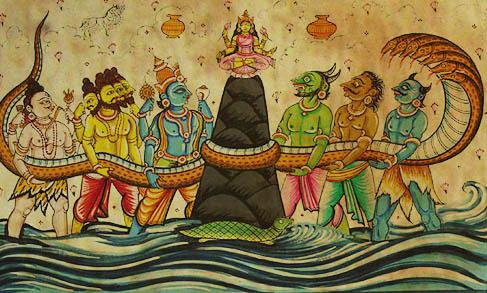
The legend of Samudramanthan is at the heart of these celebrations. Once, Indra ignored Sage Durvasa’s presence. In a fit of temper, he cursed Indra: “The pride of wealth has entered your head, so let Lakshmi forsake you.” Lakshmi is the goddess of wealth, opulence and radiance. So, when She left Indra, His life became miserable. The demons, waiting for such an opportunity, invaded heaven defeating Indra and the Gods in war, occupying the heavenly realms. As Indra had lost His kingdom, He hid out of sight of the demons.
A number of years passed. Indra’s Guru, Brihaspati, then thought of finding a way to rid Indra’s of His misery. He, along with the Gods, went to Lord Brahma, who then guided them to Lord Vishnu and put forth the appeal of the Gods. Lord Vishnu said:
“Don’t fear, I will show you a way out. The sea of milk must be churned. It is a very difficult job. Therefore, gain the friendship of the demons and get their assistance; use the Mandara Mountain as a churning rod and Vasuki, the King of the Serpents, as a rope.
I will come to your assistance at the proper time. When the sea is churned, ambrosia will be produced. The Gods must drink it and become immortal. It will then be possible for you to defeat the demons. When the sea is churned, Lakshmi who has disappeared will appear again. Her grace will be bestowed on you.”
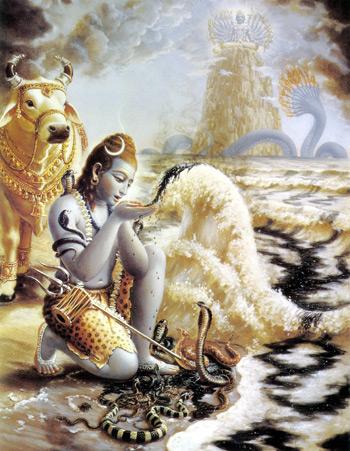
The clever Brihaspati managed to strike a friendship with the demons who agreed in the hope of getting ambrosia and wealth. After initial difficulties posed by the sinking of mount Mandara into the milky sea, Lord Vishnu took the form of a tortoise and hoisted it on his back, allowing the churning to commence. First, Kalakuta, a dreadful poison was produced which Lord Shiva drank much to the relief of the Gods and demons. Due to Vishnu’s continued encouragement, the Gods and demons continued churning the sea. Then a horse by the name Uchaishravas, Kalpavriksha and Kamdhenu, a wish fulfilling tree and cow respectively, along with other celestial articles took shape. When the sea continued to be churned the Apsara damsels were born.
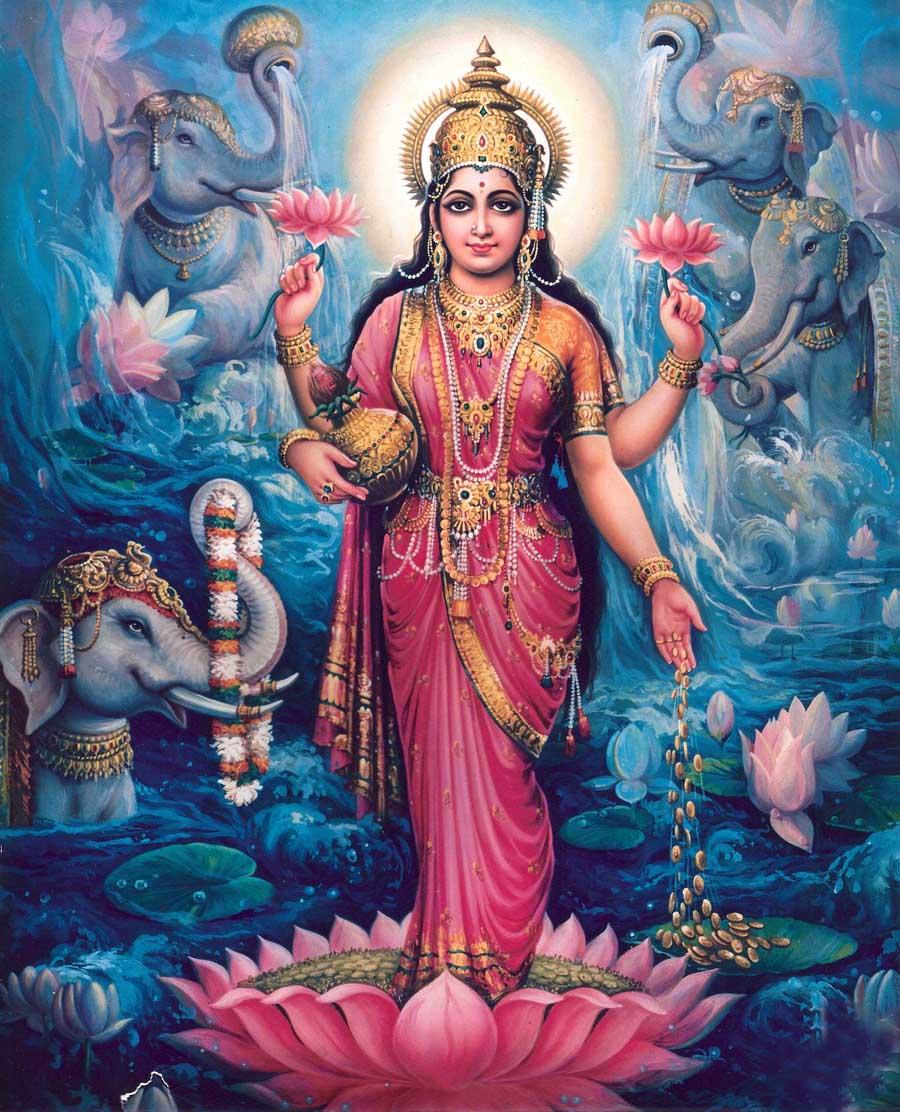
After the emergence of these articles, an extraordinary spectacle unfolded. In the midst of the waves of the sea of milk, a Goddess with an otherworldly presence materialized, standing on a fully blossomed lotus. She was adorned with the most exquisite jewels and a lotus garland, with a lotus in Her hand. Her appearance was most attractive. Smiling radiantly and exuding brilliance and majesty, She was Lakshmi Herself.
The sages began reciting hymns in praise of her. Gandharvas sang. Apsaras danced. The elephants on either side sprinkled sacred holy Ganga water on the Goddess and bathed Her. The king of the sea appeared in his natural form and comforted Lakshmi as a daughter. He presented Her with attractive clothes and jewels. He handed to Her a garland of lotus flowers. While everybody was looking in surprise, Lakshmi put the garland around the neck of Vishnu and occupied His chest. When She looked at Indra kindly, He acquired an extraordinary radiance and regained His power.
The Gods and demons continued to churn the ocean for Amrut or nectar. Finally Dhanavantri emerged carrying a jar of the elixir (ambrosia). Both the Gods and the demons wanted the ambrosia, but with a clever slight of hand, Lord Vishnu managed to procure the immortal nectar for the Gods, defeating the demons. Thus the churning of the ocean resulted in the immortality of the Gods, the re-emergence of Lakshmi and the incarnation of Dhanvantari, the bestower of health and longevity.
Another very interesting story about this day regards the sixteen year old son of King Hima. As per his horoscope he was doomed to die by a snake-bite on the fourth day of his marriage. On that particular fourth day of his marriage his young wife did not allow him to sleep. She laid all of her ornaments, gold and silver coins and other such valuables in a heap at the entrance of her husband’s boudoir and lighted innumerable lamps everywhere. She went on telling stories and singing songs all night. When Yama, the God of Death arrived there in the guise of a serpent, his eyes got blinded by the dazzling lights and he could not enter the Prince’s chamber. So he climbed on top of the heap of the ornaments and coins and sat there all night listening to the melodious songs. In the morning he quietly went away.
Thus the young wife saved her husband from the clutches of death. Since then this day of Dhanteras came to be known as the day of Yamadeepdaan and lamps are kept burning throughout the night in reverential adoration to Yama, the god of Death.
Dhanteras falls on the thirteenth day of the month of Aashwin. ‘Dhan’ means wealth, and according to Hindu scriptures, wealth should be used in accordance to Dharma – it should be earned by one’s own hard work and through honesty, and should be used in ways that not only benefit ourselves, but our community at large. The Law of Karma states that wealth acquired by any other means, such as dishonesty or deceit, or wealth accrued selfishly and with greed cause discord in one’s life as well as in society. Lakshmi, as the Goddess of wealth and in the form of currency, is therefore offered pujan to grant us the virtue and wisdom of using opulence appropriately.
This day of the Diwali period is of great importance for the rich mercantile community of Western India. Houses and business premises are renovated and decorated. Entrances are made colourful with lovely traditional motifs of Rangoli designs to welcome the Goddess of wealth and prosperity. To indicate Her long-awaited arrival, small footprints are drawn with rice flour and vermilion powder all over the houses. Lamps are kept burning all through the nights. As a source of income and a measure of currency in the past, cattle are often adorned and worshipped on this day.
As this day is believed to be auspicious, women purchase some gold or silver or at least one or two new utensils. Lakshmi Puja is performed in the evenings when tiny diyas of clay are lighted to drive away the shadows of evil spirits. Bhajans, or devotional songs, in praise of Goddess Lakshmi are sung and Naivedya of traditional sweets is offered to the Goddess. There is a peculiar custom in Maharashtra to lightly pound dry coriander seeds with jaggery and offer as Naivedya.
‘Kali Chaudash’
2nd November 2013 (14th Aashwin)
Kali Chaudash falls on the second last day of the Hindu calendar. This day is also known as ‘Narak Chaturdashi’ because Lord Krishna vanquished Narkaasur, a demon who had captured many divine and celestial objects.
Devotees pray and offer pujan to Hanumanji to remove inauspiciousness and fear of evil spirits and beings.
Origin
The evil king Narkaasur, also known as Bhaumaasur, of Prag-Jyotishpur, confiscated all the beautiful and valuable objects in the world. Rampaging through the 3 ‘lokas‘, he also looted the ear-rings of Aditi, Mother of the Devas.
When the Devas prayed for assistance, Shri Krishna and Satyabhama vanquished Narkaasur, releasing the 16,000 women captives. In jubilation, the Devas celebrated the occasion by lighting ‘divas‘. When Narkaasur lay dying, he prayed to Shri Krishna, “Let those who bathe before sunrise on my death anniversary not go to hell.” The Lord granted the boon, and therefore, many people wake up early on this day to bathe, dressing themselves in new and beautiful clothes.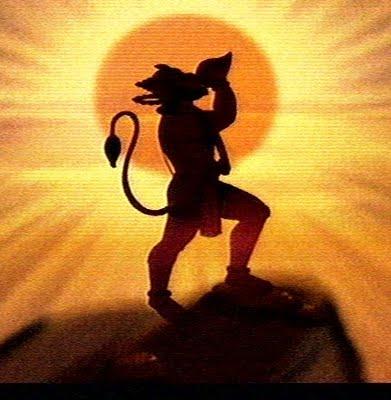
Hanumanji is the dispeller of fear and darkness, and in the wake of the return of the light, Lord Rama, Hanumanji destroys evil spirits, influences and tendencies on this day.