
By NHSF (UK) Learning Team
How competing on the sports field unlocks our deepest potential.
John Motson: “…Messi through on goal, he must surely score, he shoots! Keeper saves it!”
Brian Moore: “Buddha’s caught the ball and somehow saved a certain goal?! Coach Krishna has a mischievous grin as Messi turns away shocked at how he could miss such a sure opportunity to score.”
John Motson: “Captain Sri Rama urges his side forward now to continue their onslaught for the remaining five minutes…this truly has been a comprehensive win for the Devas. And Manu’s dream 11 have much to ponder after this…what can only be called annihilation.”
If not all of us then certainly every adolescent boy at some stage has dreamt about managing the ultimate dream team. Well imagine this…a team with Buddha in goal, Sri Rama as captain at centre back, Indra upfront, with Sarasvati and Lakshmi pulling the strings in the middle of the park. Your ultimate team.
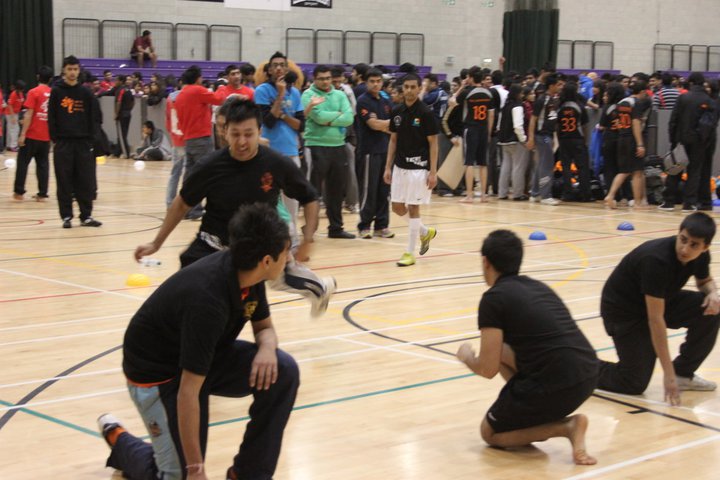
The allegory of Devas out playing Manu’s dream 11 with Messi in the team may be a stretch too far, but it is fitting to understand what a team full of Bhagavans, i.e. enlightened beings would be like. Sports, and competitive sports at that, is certainly one of those life activities which brings about a deep inner potential through complete and total concentration in the here and now. Anyone that has been in that moment of scoring a goal, or making the winning shot in a netball match, or being chased in Kho Kho knows how a simple khel can take over one’s entire being. We think of nothing else but that which is in the here and now. We have no distractions; we have no worries or anxieties; we have no past or future; and most of all we have no thoughts. In playing competitive sport, there is a certain type of stillness we all experience. It is in that momentary stillness, where we become the sport, that there is the unlocking of our inner potential – our true Dharma.
To become really good at a sport takes discipline, focus and concentration; and it takes a certain psychology, at least in team sports, where one knows implicitly that ‘there is no I in team’. But, on closer reflection we also realise that by simply playing a khel, initially for pleasure, builds these exact competencies. A team sport naturally brings out a ‘we’ attitude rather than an ‘I’ or ‘me’; we naturally start to dissolve our own self-interest into the wider team interest, and one could argue that this is what we mean by a ‘Parivaar’, a family; where the whole is more important than my own narrow interests.
During our sports competition whilst we may be vying for that top spot, let us also be aware of those momentary silences where we experience the loss of ‘I’; where we naturally work together as a parivaar and at the end, of how our discipline through practice has allowed us to excel and perfect ourselves in our sport. And can we take these experiences and mind-set beyond the sports field? Can we apply ourselves just as passionately to our work?
The ball is in your court !