
We have all heard of the epic tale known as the “Ramayana”. Some of us may not know it in great detail, but have definitely been taught the story of Shri Rama and Sita mata – whether it was at the mandir, home or school. Roughly translated, ‘Ramayana’ means ‘Ram’s Journey’. The epic is an integral part of Hindu literature, exploring themes of duties, righteousness and yes, good and evil.
Before delving into the essential theme of good and evil, we must briefly consider the traits Shri Rama and Sita mata have taught us. Shri Rama has taught and still teaches the world, through his actions alone, how to live a life as an ideal man, son, brother, friend and a husband; he had a devoted wife whom everyone admired, which brings us to Sita mata. Known for her dedication, valour and purity, Sita mata is the embodiment of the ideal woman, daughter, sister and wife. In this day and age, one can only talk about being the ideal person, but it is easier said than done. Providing we strive to change for the better, regardless of whether we become the ideal person or not, we are definitely progressing as human beings.
At NHSF (UK), we encourage all to do Sewa; not just on Sewa Day, but perform such activities daily without keeping count. To me, Sewa is sacrifice. Sacrifice is when we think less and less about ourselves, and more and more about others. It is to give ourselves to service. It is to give a part of what we have – whether this is a part of our time, our wealth, a kind word, a helping hand or a supporting shoulder. Such little deeds of service are sacrifices, and to do them daily without keeping count is real sacrifice, and therefore, Sewa.
Some of the readers may be wondering why I bring up the topic of Sewa. This now brings us to the vital theme of good and evil. Lakshmana himself, Shri Ram’s brother, symbolises the ideal of sacrifice. He leaves the luxuries of the palace, and his wife (Urmila) to accompany his brother in exile. Lakshmana, known to be the avatar of Sheshanaga; the great serpent, which Lord Vishnu rests upon, accompanied Shri Ram and Sita mata in exile to protect them. He does this by sacrificing sleep for fourteen years! The sceptics amongst the readers will surely question this in that the divinity taking form of an ordinary man cannot go fourteen years without sleep – and I question this too. However, reflecting on this further, we merely understand the world from what we see and observe today – it’s relative. Additionally, one could say it was a psychiatric mind trick hypnotising someone to be awake, by convincing him that someone (Urmila, his wife) is sleeping on his behalf.
For all the duties of sacrifice Lakshmana presented in the Ramayana, he was still human and had his flaws, being temperamental and having a slight arrogance about his persona. Nonetheless, these more “negative” traits slowly deteriorated through the support of Ravana himself, who set Lakshmana on the right path.
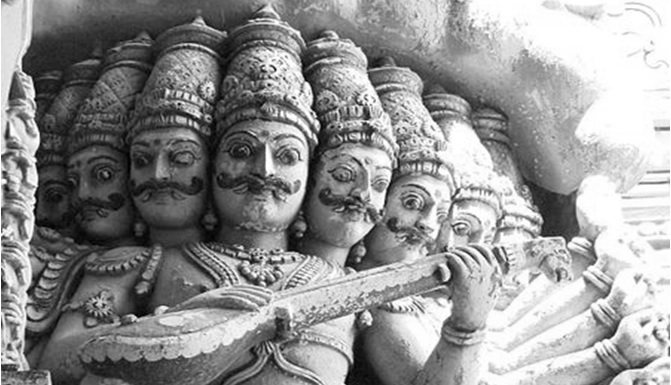
Ravana, the king of Lanka, was a wicked yet great scholar. The ten heads he is described to have are said to symbolise the mastery of the four Vedas and six Shastras – making him the most intelligent being of that time; and thus his ten heads stood for the multiplicity of his genius. Though a great scholar, Ravana, through his ten heads, personified the ten negative interpretations, emotions and senses in a human – Kaam (lust), Krodha (anger), Moha (delusion), Lobha (greed), Mada (pride), Maatsarya (envy), Ahamkara (ego), Matasara (jealousy), Manas (the mind) and Buddhi (Intellect). The importance of controlling one’s senses and projecting just the intellect alone is considered paramount in Hinduism. Upon advice given to Ravana to shun these nine emotions and only keep intellect, Ravana replies that the possession of these facets are all equally important and complete him as a being. Ravana had no control over his senses and desires, which lead to his demise.
Towards the end of the battle, when Shri Ram rescues Sita mata, Ravana was struck by Shri Ram and was nearing death. Shri Ram asked his younger brother, Lakshmana, to go to Ravana, to learn something that no other person except for the great scholar (Ravana) could ever teach him. Lakshmana, obeying his brother, rushed over to Ravana. Ravana said to Lakshmana that if he has come to him as a student, he must sit at his feet as the teacher must be respected, thus breaking Lakshmana’s ego.
Seeing Lakshmana at his feet, Ravana taught Lakshmana many things, but the most compelling and the one that I will leave you with is…
“You must defer bad actions as much as you can, keep delaying them.
Once a good, noble action comes about, you must do this without delay and as early as you can.”
– Author: Punit Vara, National General Secretary